
Ossining Resident Lookup Sources
No single record answers every question. The Town of Ossining assessment roll links a name to a tax parcel. Its parcel tools do the same work. That mailing address may be misleading, though. It can belong to an agent or a post-office box. It may also belong to an owner who lives somewhere else entirely. New York's online voter service only lets a person check that person's own registration status. A supervised Board of Elections record has a different scope. Court, vital, probate, business, and archival records sit with their own custodians. Each has its own access rules.
| Record | What It Confirms | Where | Access |
|---|---|---|---|
| Assessment or parcel record | Parcel identity, assessed owner, and possible mailing address | Town of Ossining Assessor and Village or County GIS | Public roll or viewer fields vary; a mailing address does not prove occupancy |
| Voter registration material | Registration status or a supervised registration record | NYS voter registration status lookup and Westchester Board of Elections | Own status online; inspection is supervised under Election Law §3-220 |
| Court index | Party name, case number, court, type, date, and status | NYS eCourts, Ossining Town Court, and WRO Legal | Public only where not sealed or otherwise restricted |
| Vital and marriage indexes | Historical relationship, date, and place leads | Ossining local registrar, NYS DOH, and Westchester Archives | Indexes are discovery aids; certificates have eligibility rules |
| Probate, business, or license record | Estate role, affiliation, service address, or active license detail | Archives, Surrogate's Court, NY DOS, and County Clerk | Use the stated record purpose and do not treat a business address as a home |
Property questions start with a parcel or title source. Turn to the right custodian instead when the person touches a court matter, a family tree, or an official license. A license city or ZIP can support a business connection. New York's license data leaves residence addresses out. For a former resident, an obituary, city directory, deed chain, or estate file is the stronger lead. Current-record searches rarely reach back that far.
Ossining Lookup Name Checks
A same-name hit is a lead, not an identification. Keep every detail intact. That means middle initials, full middle names, suffixes, married and maiden names, accents, and alternate spelling order. Older material may say Sing Sing rather than Ossining. Search both place names when the period calls for it, then anchor the comparison on a neutral field. A parcel SBL, an approximate age, a spouse, an occupation, a business entity, a court number, or a prior address all work well.
Compare records side by side. Never merge them by name alone. A deed establishes a title transfer. An assessment record ties title to a tax parcel and a mailing field, while a court docket backs up a name, court, and date. Probate or an obituary can fix a family relationship for someone deceased. If the records disagree, leave the identity open. An off-site tax address, inactive voter status, and a business service address each mean something other than current residence.
Record trail. Name variant → parcel or date clue → independent index → custodian copy request. Keep the record number and source with each step.
Ossining Resident Lookup Court Trails
NYS eCourts bundles several search products under one roof. WebCivil Local, WebCivil Supreme, WebCriminal, WebFamily, eTrack, and NYSCEF guest search all live there. Search behavior shifts with the product and case type. WebCivil Local covers local civil cases statewide. WebCivil Supreme handles Supreme civil matters. Westchester Records Online Legal searches by record type, party, file or index number, and date range. Its own description covers civil information from 1980 forward and criminal information from 1978 forward.
County Clerk terminals show documents filed from 2002 forward. Request older files in advance. A case begun earlier may need a clerk or County Clerk request. Town Court, County and Supreme Court, Family Court, and Surrogate's Court are separate channels, and family, adoption, matrimonial, juvenile, and sealed matters carry limits even when a name seems searchable.
| Search field | How it narrows the court search |
|---|---|
| Search product | Choose WebCivil Local, WebCivil Supreme, WebCriminal, WebFamily, eTrack, or NYSCEF guest search. |
| Party name | Try surname, first name or initial, and documented variants. |
| Case, index, or file number | An exact number is the strongest match; WRO accepts file and index numbers. |
| County or court | Select Westchester and the relevant court, including Ossining Town Court for local matters. |
| Date range or status | WRO permits date-range limits; public status, calendar, and disposition views vary by product. |
The eCourts search hub shows the court-search families used for this work.
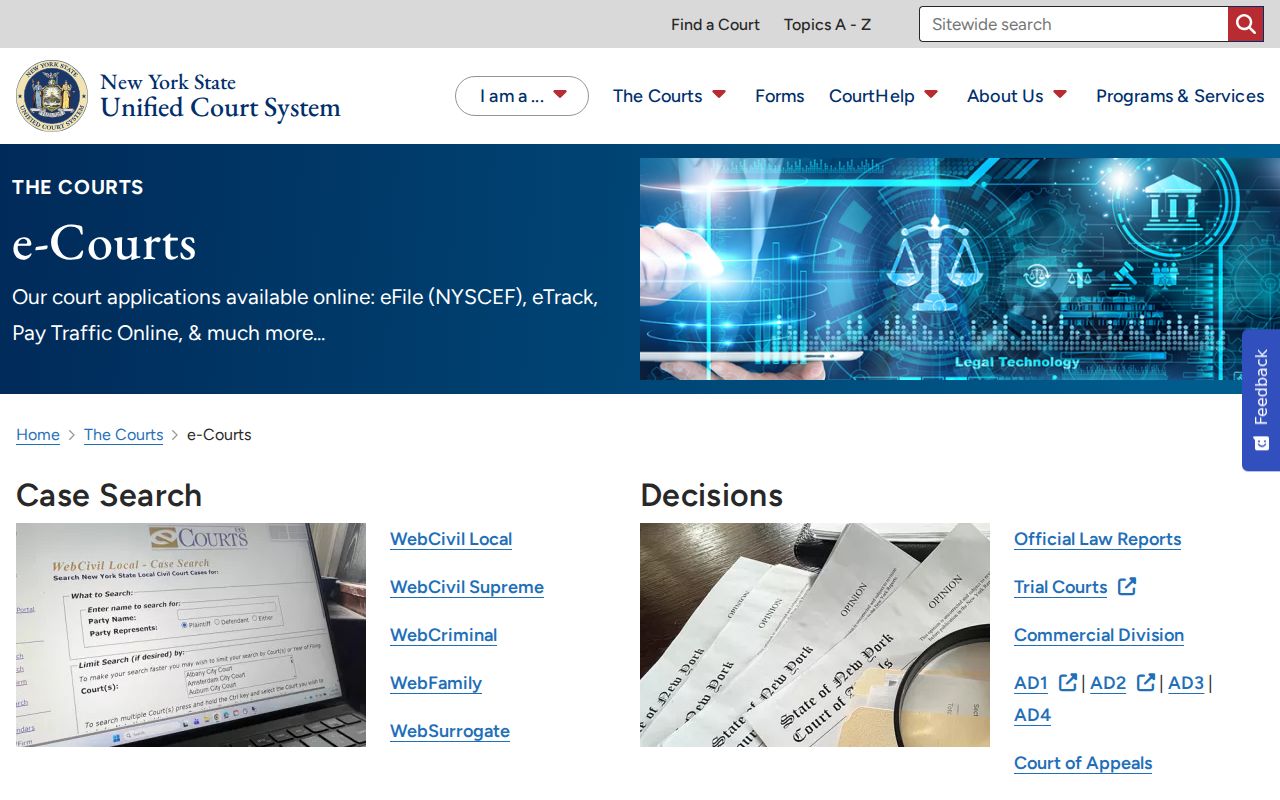
A public docket or index result can list party name and role, case or index number, court, category, activity dates, status, and calendar or disposition details where the product exposes them. NYSCEF links e-filed documents. WRO images may require an account or subscription. None of that proves identity. A docket hit alone does not confirm the same-named person is the one you want.
Ossining Resident Record Evidence
Property and voter records answer different questions. A parcel viewer shows the situs. That is the physical parcel address. Sometimes an owner or mailing field is supplied by the municipality. The Town Assessor's roll is the official assessment starting point. Village and County GIS tools add parcel geography and tax-map identifiers. County GIS warns that ownership attributes can be incomplete and parcel lines are approximate. The approved local assessor tax map controls.
New York's voter registration status lookup is not a public name-and-address directory. It checks one registrant's own registration, polling, or ballot status. Election Law §3-220 instead allows supervised inspection of registration records through the Board of Elections. That inspection is subject to reasonable regulations. Some fields stay protected. Driver-license and non-driver ID numbers, Social Security numbers, and facsimile numbers are never released. Protected-voter records are never released either. Participation information never reveals ballot choices.
The state voter lookup is the self-service status route.
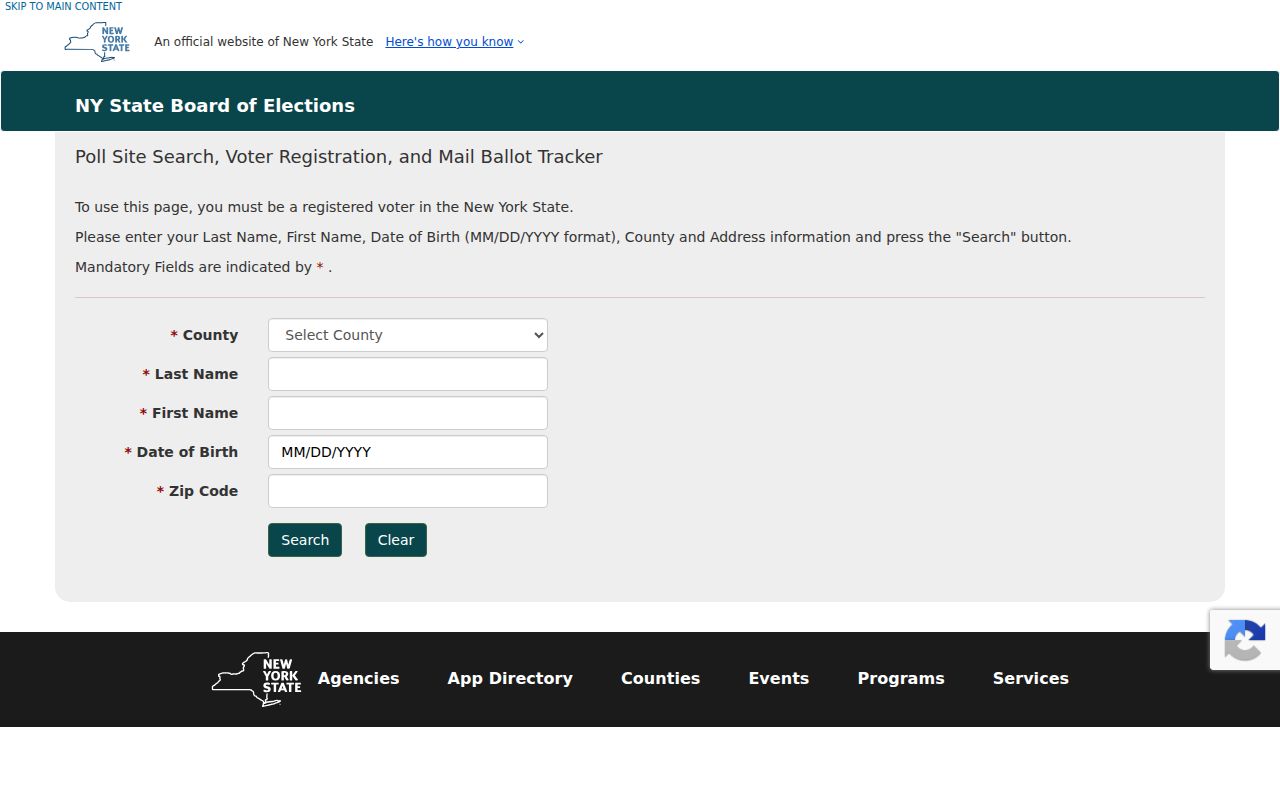
Ask the Westchester Board of Elections about supervised inspection. Copying, historical poll books, and permitted formats are fair questions too. Name the municipality, date, or election district. Say whether you want inspection or a copy. Never infer current occupancy from a registration entry, and never try to rebuild a confidential address from a mailing record.
Ossining Resident Vital Records
The Village and Town Clerk at 16 Croton Avenue serves as local registrar for births and deaths in the Village and Town of Ossining. The statewide route for certified copies and genealogy requests is the NYS Department of Health. Westchester Archives holds the 1908-1935 marriage collection and historical town-return indexes, though it is not the general custodian for local vital records. Each route answers a different need. A historical index only points to a possible record. It is not a certificate.
New York opens old records on a set schedule. Births generally become available after 75 years when the person is known deceased. Deaths open after 50 years. A marriage opens after 50 years once both spouses are known deceased. A direct-line descendant may seek a waiver with proof of relationship and the death conditions. The DOH-4384 form asks for the applicant's contact and relationship information, plus event-specific fields such as names, date, place, and parents or spouse. The base fee is $22 for a one-to-three-year genealogy search. Processing can take eight months or longer.
Certified access to current records is separate. Public Health Law §§4174 and 4139 and Domestic Relations Law §20 control who may receive certified birth, death, and marriage copies. Call the local registrar before a local request to confirm current fees and turnaround. Vital records stay confidential. FOIL does not supply them.
Ossining Resident Probate Leads
Probate research in Westchester County starts with the Surrogate Records Index at Westchester Archives. Search by last name, first name, or year. A partial name or a bare year widens the net. Each hit lists last name, first name, year, and town name. It also lists record type, box information, and file number. The index holds 83,959 records. That is a deep bench for Ossining families. A probate file can identify an executor, spouse, heirs, estate property, or addresses in filings. The full file still must be requested through the proper archive or court channel.
Start with a name. An approximate year narrows the field. Save the town, record type, box, and file number from a promising index result. Then request the will or estate inventory. Compare its family details against deeds and obituary notices. Westchester Archives indexes Surrogate records from 1775 to 1941. Modern matters follow the county Surrogate's Court route. NY Courts notes that probate wills have been filed with the Surrogate's Court in each county since 1787. Appointments or fees may apply.
Older directories and yearbooks can help identify a household before an estate search. The Ossining Directory is the local route for those historical volumes. It is not a substitute for probate evidence.
Ossining Lookup Custodian Requests
New York's Freedom of Information Law opens existing agency records to the public. FOIL never forces an office to build a list. A strong request names the actual custodian, the record type, an address or name, and a useful date range. Village policy routes electronic requests to village.foil@villageofossining.org, and the Town form uses town.foil@townofossining.com. Each custodian holds different records. Land records go to the County Clerk's Land Records Division. Court files go to the clerk or Legal Division. Vital records are a registrar matter, handled by the local registrar or DOH instead of FOIL.
Under Public Officers Law §89(3)(a), an agency generally has five business days to grant or deny access, or to acknowledge the request and give an approximate response date. FOIL permits privacy redactions. It also allows withholding where another statute protects the material. A narrow request works best. Name the record. Ask for a defined permit, meeting record, or agency file rather than a search for a person.
The Town of Ossining FOIL form shows the requester, contact, subject, date, release-method, address, and description fields used for a specific records request.
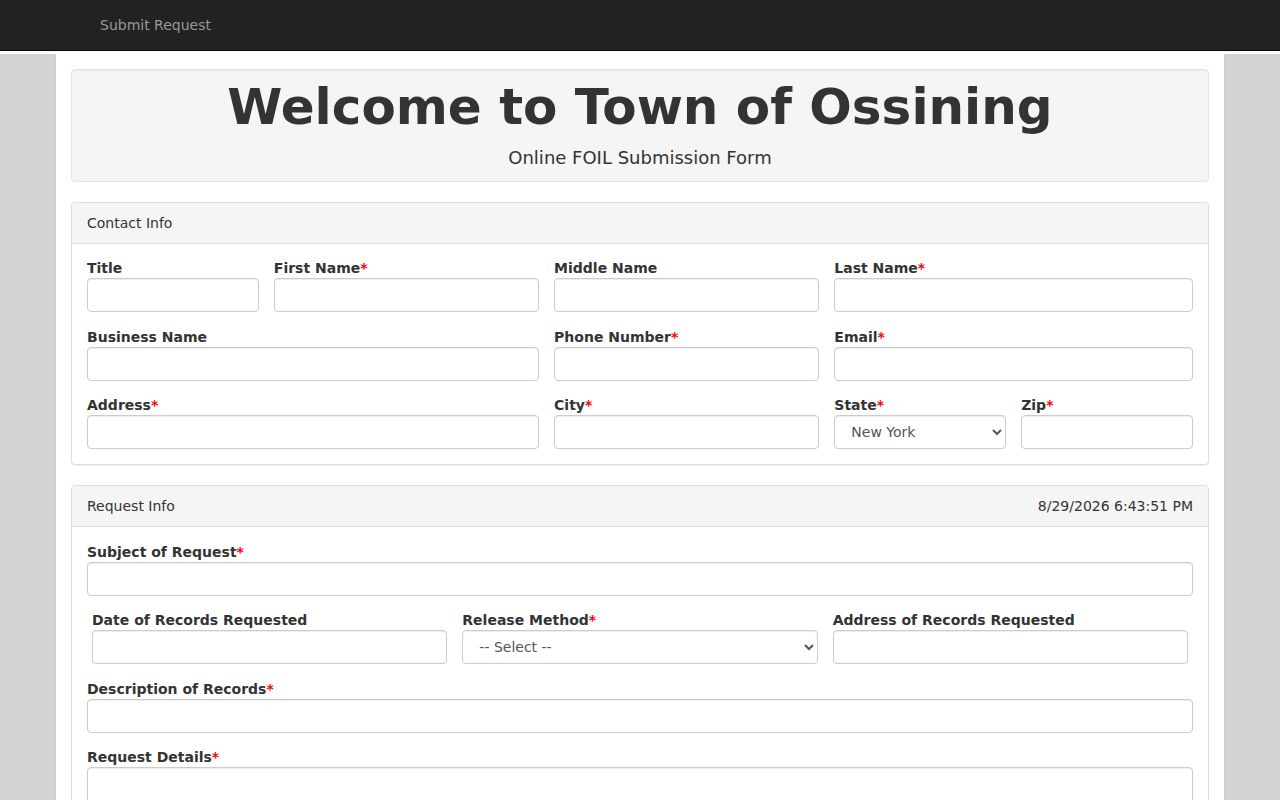
Keep the submitted request and the precise record reference. If information turns out wrong, contact the custodian directly. The Assessor handles assessment issues. The Board of Elections corrects registration problems. Court dockets and sealing questions go to the court clerk, recording and index issues to the County Clerk, and vital-record amendments to DOH or the local registrar.
Confirm an Ossining Resident Carefully
Use a recorded sequence when results matter. Begin with a name variant and a non-sensitive fact already tied to the person. Then check independent records. Each record should answer a different question. A certified copy helps only when the custodian permits it and the purpose requires it. Never assume a court party, parcel owner, or record recipient is the same person.
- Record the full name, known variants, and one non-sensitive anchor such as a year, spouse, SBL, prior address, or case number.
- Use the appropriate parcel, court, business, or archive index, and save the record number, date, and custodian rather than only the displayed name.
- Compare a second independent source. A title record, court index, probate file, or historical vital index should corroborate a different part of the identity.
- Ask the custodian how to obtain the specific underlying record when a copy is needed. Do not request restricted details by phone.
- Docket
- A court's running case record, usually organized by a case number, parties, dates, and events.
- Index versus image
- An index points to a record. The document image is the underlying filed page and may require an account, fee, or counter request.
- Certified copy
- A custodian-issued copy carrying official certification. Eligibility, charges, and use vary by record type.
Ossining Resident Lookup Limits
Some limits are absolute. CPL §160.50 seals favorable criminal outcomes. CPL §720.35 seals youthful-offender records. Juvenile matters routed to Family Court carry special protections of their own. Family Court files, adoption records, matrimonial information, and confidential vital records sit outside broad public search. Under the Driver's Privacy Protection Act, there is no general name-to-address search of DMV data either.
Two shields deserve particular care. The New York State Address Confidentiality Program gives eligible people a substitute mailing address. Election Law §5-508 offers a confidential-voter procedure for qualifying victims. Never attempt to work around either protection through a parcel mailing field, a voter record, or a court filing. FOIL's privacy provisions, found in Public Officers Law §§87(2)(b) and 89(2), likewise permit redaction where disclosure would be an unwarranted invasion of personal privacy.
Lawful personal use. Use records for personal, family-history, estate, civic, or safety-related research. Using information to stalk, harass, threaten, or intimidate anyone is prohibited.