
Finding Ossining Residents by Record
Ossining sits within Westchester County, while the Village and Town keep some local records. That split matters. An address question normally starts with a parcel, a named-person question calls for several independent checks, and an older household needs archival material. An owner on an assessment roll is not automatically an occupant. A mailing address may belong to an agent, estate, or post-office box. Treat every result as a dated lead, then match it to another record with the same address, legal parcel description, relative, or document number.
The strongest current trail is usually parcel to owner, owner to recorded deed, then deed to the prior party. For a historical family, a directory, census schedule, newspaper notice, probate file, or cemetery ledger may add the missing household detail. The Village Clerk, County Clerk, Archives, and library each provide a different channel when a web search does not reach the needed record.
- Start an address with the Village parcel mapping tool or the County parcel viewer. Save the Section, Block, and Lot, also called SBL, when it appears.
- Use the owner name and a date range in Westchester Records Online to locate a deed or recorded instrument index entry.
- For a registration question, use the State tool only for the registrant's own status or seek supervised access through the elections office.
- For an old household, compare an Ossining directory year with a census year and local newspaper material.
- When an item is not online, ask the actual custodian for a copy, counter search, archive retrieval, or a focused FOIL request.
Ossining Resident Records Custodians
Each custodian keeps a different kind of evidence. The Village Clerk is the starting point for municipal records and local registrar questions. The Town Assessor and parcel tools identify land records. Westchester County Clerk records connect parties to deeds and legal filings. The county and State elections offices handle voter material under New York law. A record should be requested from the office that made or holds it, rather than from an unrelated portal.
Westchester County Clerk
110 Dr. Martin Luther King Jr. Boulevard
White Plains, NY 10601
Weekdays, 8:30 a.m. to 4:30 p.m.
Village of Ossining Clerk
16 Croton Avenue
Ossining, NY 10562
914-762-8428, weekdays 9 a.m. to 4:30 p.m.
Westchester Board of Elections
25 Quarropas Street
White Plains, NY 10601
914-995-7814
Ossining Parcels and Resident Clues
The Village tool and Westchester GIS can move an address from a vague street reference to a defined parcel. Documented fields include parcel address, owner, mailing address, municipal parcel ID, SBL, book and page, roll year, and spatial year. The Village tool also describes property class, parcel dimensions, easements, rights of way, and sewer information. Those fields make a parcel useful for identifying a record trail, not for declaring who is currently inside a home.
The county viewer is a discovery map. Its ownership data can be incomplete, its boundary lines are approximate, and the local assessor's approved tax map controls. A parcel's situs address means where the land is. Its mailing address means where tax correspondence goes. The two fields can point to entirely different places.
| Parcel field | Use in an Ossining search | Important limit |
|---|---|---|
| Owner or primary owner | Names a title or assessment lead | Does not prove occupancy |
| Situs address | Connects a location to GIS, permits, and code records | May differ from a mailing address |
| SBL or municipal parcel ID | Bridges a parcel to deeds, maps, and historical descriptions | Use the official tax map for control |
| Book, page, or legal description | Helps locate the recorded title trail | Early deeds may lack a modern street number |
Note: Parcel attributes are a starting point for records work, and a local assessor map remains the controlling source for exact boundaries.
Westchester Deeds for Ossining Names
Westchester Records Online, known as WRO, combines Land, Legal, and Maps searches. It advertises land records reaching back to eighteenth-century deeds and legal entries as recent as the prior week. The index can be searched without payment. Viewing images or reports requires a registered account and subscription, so a County Clerk counter request is the practical fallback when an image matters.
Search a current title holder as a grantee around an apparent purchase date. The prior grantor becomes the next name to test. Record the instrument number, liber and page, recording date, and legal description. A legal description or SBL is safer than relying only on a street number, especially where lots changed shape. The historic alternative is the Westchester Archives grantor and grantee index, which covers 1680 through 1907.
- Grantor
- The party transferring an interest in a recorded document.
- Grantee
- The party receiving that interest.
- Liber and page
- A book-and-page reference used in older recording systems.
- Index
- A finding tool that identifies a record; it is not always the document image.
Current Ossining Resident Directory Sources
No single current list covers every Ossining household. The useful sources are narrow by design. Assessment and GIS records address ownership and parcel geography. Recorded instruments name parties to title or liens. Voter registration material is governed by a separate public-access rule. Local boards, licenses, and tax bills can identify people in a government activity or address context, but none should be treated as a complete resident roll.
| Ossining source | What it can establish | Custodian | Access route |
|---|---|---|---|
| Assessment roll and parcel viewer | Owner, parcel, possible mailing address, tax-map identity | Town Assessor and GIS offices | Roll, viewer, phone, or records request |
| WRO land index | Parties to deeds, mortgages, liens, and maps | Westchester County Clerk | Free index; account images; counter or mail alternative |
| Village tax bill search | Current or unpaid bill details by name or address | Village Treasurer | Online lookup; paid bills drop off |
| Registration records | Status or supervised registration material | State and County Boards of Elections | Own-status tool or Board-supervised access |
| Village meetings and permits | Applicants, owners, or public participants in a stated matter | Village Clerk and Building/Planning | Meeting material, office request, or FOIL |
A person-specific question needs independent checks. The Ossining resident lookup route separates title, court, archive, and vital-record questions rather than treating one name hit as a match.
New York Voter Records in Ossining
The New York voter-status lookup is intended for a person to check that person's own registration and election information. It is not a public name-and-address directory. New York Election Law section 3-220 makes registration records subject to inspection under Board supervision, while excluding driver-license numbers, non-driver identification numbers, Social Security numbers, and facsimile signatures.
Some voters have protected confidential records under Election Law section 5-508. An online result may show less than an in-office registration record. A careful request identifies the record sought and works through the Board of Elections, without trying to reconstruct a protected address.
The State voter lookup provides the official starting screen for a registrant checking status.
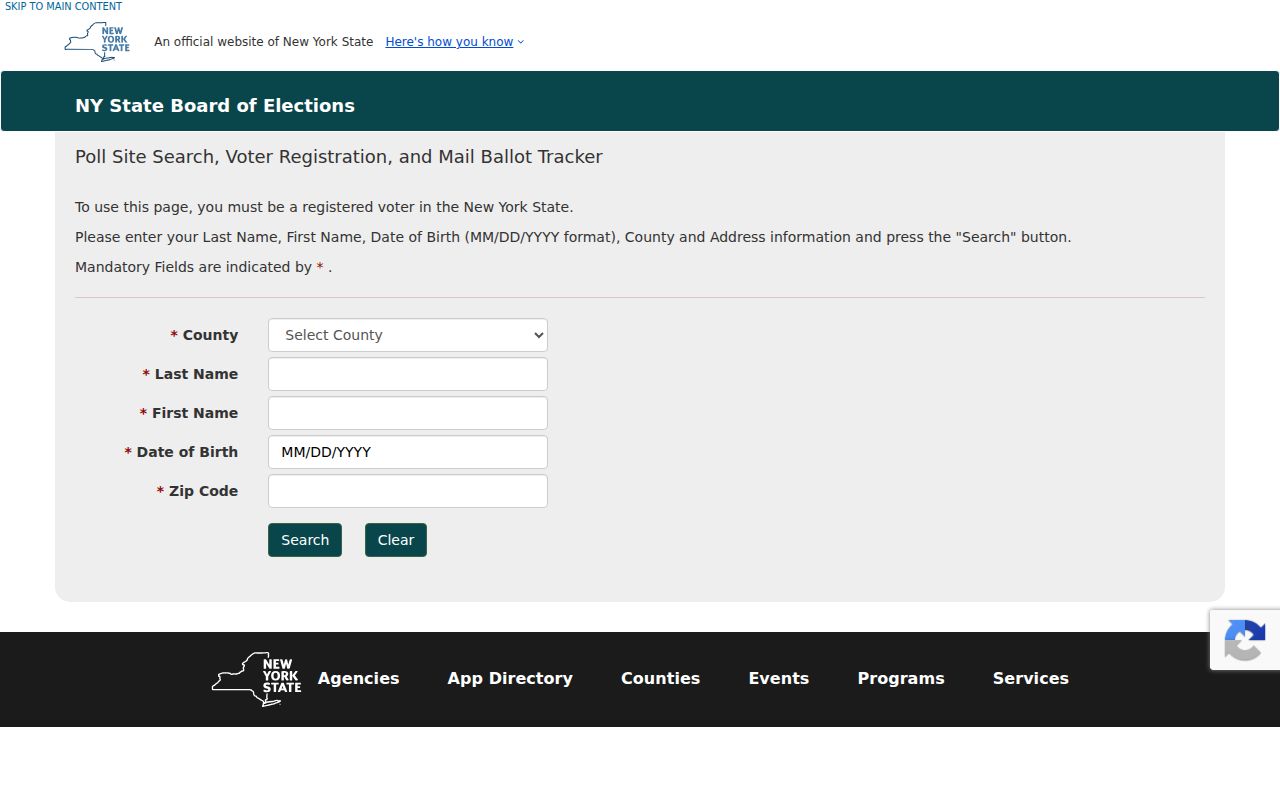
The screen reinforces that voter access is a status and election service, while fuller public records remain subject to Board procedures and statutory exclusions.
Ossining Court Records by Name
Court indexes can distinguish a legal party from a property owner, but a same-name hit is not identity proof. Ossining Town Court is in the Ninth Judicial District. The statewide eCourts hub provides WebCivil Local, WebCivil Supreme, WebCriminal, WebFamily, eTrack, and NYSCEF guest-search routes. Search behavior varies with the court and case type.
Public results can contain party names, a case or index number, court, category, filing dates, status, calendar information, or disposition data. Sealed, juvenile, Family Court, adoption, and matrimonial information have separate access limits. Westchester WRO Legal describes civil index information from 1980 and criminal information from 1978. County Clerk terminals can view documents filed from 2002, while older files should be requested ahead of time.
NYS eCourts groups the statewide court-search products used to identify the correct court and case type.
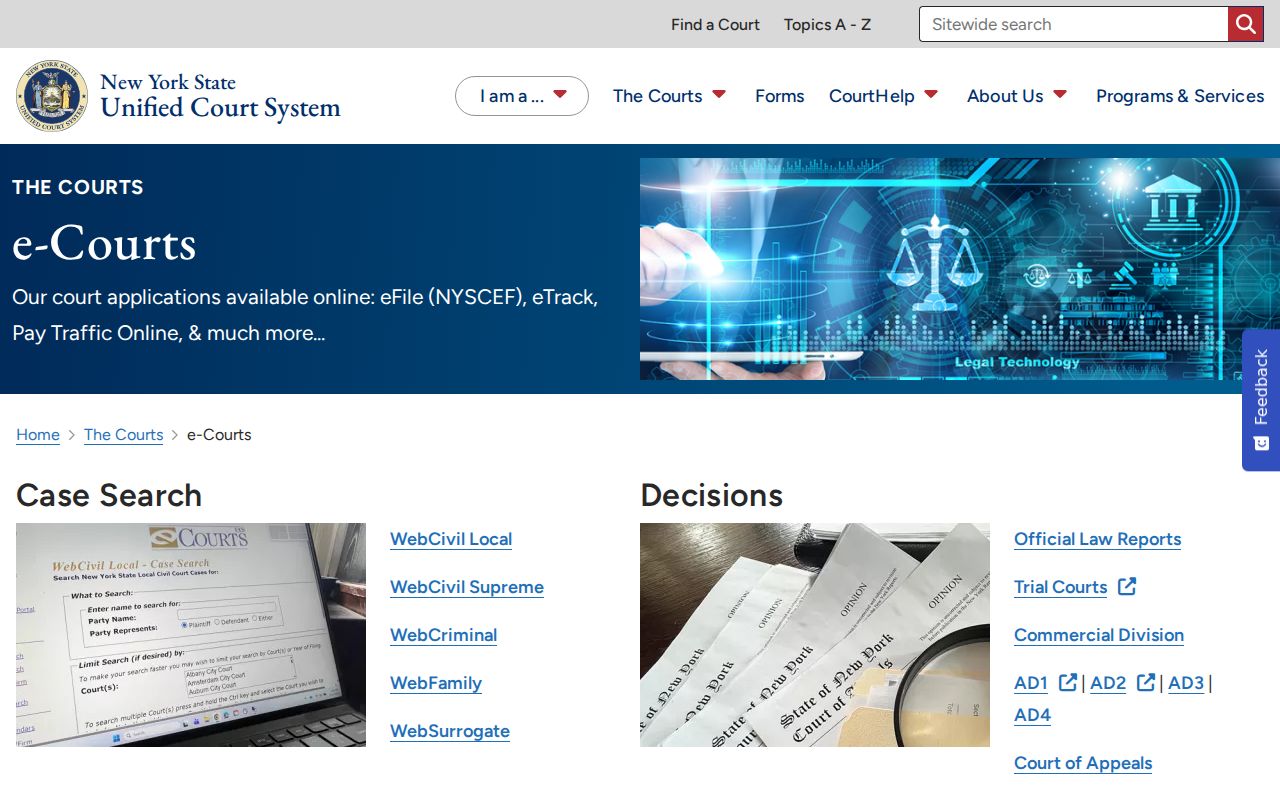
Once a case number is found, the clerk or County Clerk is the proper channel for a copy and for any question about restricted access.
Ossining Vital and Probate Paths
Vital records are not an ordinary public name index. The Village and Town Clerk is the local registrar for Ossining events, while the New York State Department of Health is the statewide route for certified and genealogy copies. Certified access depends on the record type and eligibility. Genealogy copies generally open after 75 years for a birth when the person is deceased, and after 50 years for a death or marriage, with the additional marriage rule that both spouses are deceased.
For an heir or a deceased resident, probate may be a better first source. Westchester Archives' Surrogate index searches by last name, first name, or year and reports town, record type, box, and file. A will or estate inventory can connect heirs, executors, and property. For a certificate, call the local registrar about the event year and eligibility, or use the State form. FOIL does not open confidential vital records.
Ossining Records Requests and Offline Help
When a record has no public search screen, make the request specific. The Village records policy separates its record locations: the Clerk at 16 Croton Avenue and Building and Planning at 101 Route 9A. Give an address or name, record type, department, and date range. The custodian responds to existing records and does not have to create a new list.
Westchester Archives is another important route. Its Reading Room holds deeds, maps, naturalizations, estate records, and local-history material. Researchers show photo identification and use staff-delivered items from closed storage. A specific archive search by mail is listed at $15, while custom research is $25 per hour. These channels matter when a WRO image is gated or an early record never reached a modern online index.
The Town of Ossining FOIL form shows the fields used to describe a requested record and how the response should be sent.
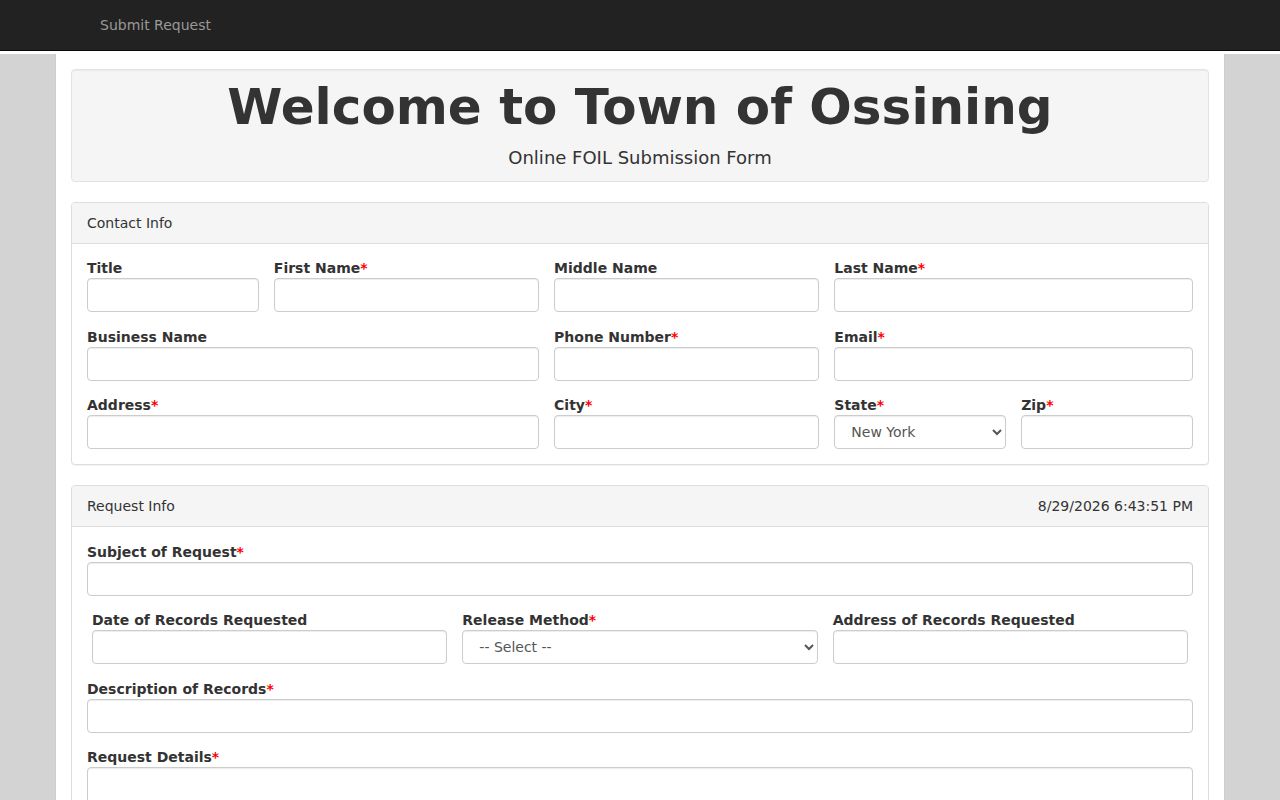
A focused request gives the custodian enough detail to search without inviting a guess about a record that may not exist.
Ossining Library Research for Residents
Ossining Public Library at 53 Croton Avenue is the practical local-history desk for old directories, yearbooks, obituary clipping files, telephone books, newspaper microfilm, and related research. Its research tools link FamilySearch, Fulton History, and Chronicling America. The library's local-history material is on the second floor; ask Reference for the format and years of a collection before making a claim from it.
The New York State Library's newspaper inventory is especially useful when a date is known. It identifies title-specific Ossining runs, including the Democratic Register, Daily Citizen, The Sing-Sing News, and Citizen Register. Search a page image after an OCR result. A library entry, newspaper notice, or directory listing can add household context, but it needs a dated official record to establish a present connection.
Ossining Public Library research tools links the main genealogy and historical-newspaper resources available through the library.
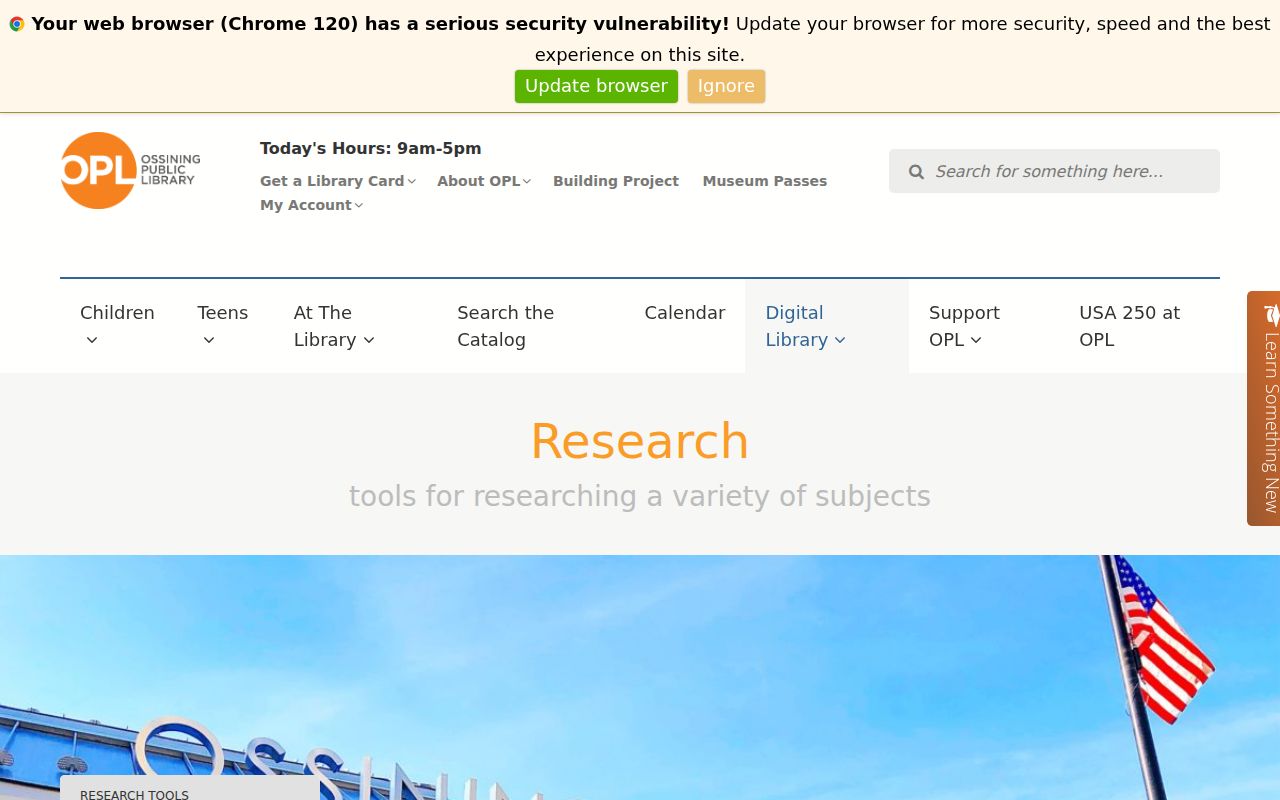
Library research works best after a name, address, or date narrows the request for a directory, yearbook, or newspaper title.
Historical Ossining Resident Directories
The identified Ossining city-directory run is 1912/13 through 1930/31 on Reel 31, with a documented break from 1916 through 1923. Digitized or indexed examples include 1912, 1914, 1924, 1926, 1928, and 1930. The gap is important: an absent listing in those missing years cannot prove a household had left.
An entry may contain a name, initial, spouse notation, occupation, address, and a household marker, depending on the volume. Its abbreviation key controls the meaning of any shorthand. Directories are evidence of compilation and subscription, not a complete roll. Pair them with census schedules, deeds, permits, probate, and newspapers. The full collection trail belongs with the Ossining city directory collections.
Ossining Names Before and After 1901
Ossining research has two local continuity traps. The Village changed its name from Sing Sing to Ossining on March 25, 1901. Sparta was annexed into the expanded Village in 1906 and 1907 after a trolley connection. Older records may therefore describe the same place as Sing Sing, Ossining, Sparta, the town, or the village.
Search both historical names when a deed, directory, newspaper, or cemetery lead falls near those dates. Compare the legal description, map, town field, and record date before deciding two entries concern one address. The local record story is more precise than a general alternate-spelling tip because the municipal labels changed on known dates.
Note: A historical place label is a search term, not proof that a modern address had the same municipal boundary.
Ossining Resident Search Boundaries
Official records have limits. Do not use a parcel line as a survey, a mailing address as proof of residence, a court hit as proof of identity, or a directory as a current roll. New York protects confidential voter records and address-confidentiality participants. Court sealing rules, adoption rules, and vital-record statutes also limit what can be released.
Free official indexes and public research rooms are usually more reliable starting points than unnamed commercial lookup services. They show a custodian, a record date, and a correction path. If a record seems wrong, contact the assessor, clerk, court, elections office, or registrar that controls it and cite the exact record number.